
The first Moroccans began to settle in and around Jerusalem when, in the 12th century, the Ottoman sultan Salaheddine called on the Moroccan sultan Yacoub El Mansour and his troops to help him reconquer the holy city.
First soldiers.
“Moroccan troops accounted for up to 20% of those involved in the liberation of Al Quds,” says Palestinian writer and diplomat Hassan Albalawi.
According to other historians, the first Moroccans settled here as early as the middle of the 10th century, occupying positions of authority, such as judges and governors. “It is impossible to understand the secret of how Moroccan existence took root in the confines of Jerusalem without taking into account the historical context that gave rise to this presence. That’s why we have to go back in history to understand why Morocco has acquired such prestige among the inhabitants of Jerusalem, and how the Moroccan presence was established in this sacred city”. @ Rabat à Al Qods, page 17, éditions BMAQ 2023, Rabat.
First of all, it should be stressed that studying the beginnings of the Moroccan presence in Jerusalem from a historical point of view is not an easy process, given the lack of conclusive scientific research on this issue. However, numerous sources indicate that some of Jerusalem’s governors during the Ikhshidid period (935-969 A.D./233-358 A.H.), which preceded the Fatimid period, were of Moroccan origin, such as Mohammed ben Ismail al-Sanhaji. The period remains to be explored to reveal the extent of the Moroccan presence in Jerusalem and the true nature of the relationship between Morocco and Jerusalem during the Ayyubid period. @ page 18
Historical research indicates that during the Fatimid period, there was a permanent or quasi-permanent Moroccan presence in Jerusalem. This is natural given the relationship between Moroccans and the Fatimid state, where they made up the majority of the Fatimid army that conquered first Egypt and then the lands of the Levant, including Palestine. Many of the Moroccan fighters who chose to join the Fatimids settled in Jerusalem, and it would not be surprising to discover that they settled in the same location where the Moroccan Quarter was later built, although this is difficult to confirm due to the lack of sufficient evidence. It is certain that Moroccans were present and settled in the city of Jerusalem during the Fatimid period. The truth is that the attention paid by the Fatimids to the holy city of Jerusalem and their consideration of its preservation as an integral part of their legitimacy in power encouraged many people to settle in this holy city, especially Moroccans passionate about the link between Rabat and Jerusalem.
However, the stability and security enjoyed by the Holy City of Jerusalem in the early Fatimid period weakened by the end of the 11th century. European Christian states took advantage of the weakness of the Fatimid and other Arab Islamic states to launch a series of crusades.
Hay Al Maghariba.
This is where the first Moroccans settled, mainly at the foot of the Mosque Esplanade from the 1180s onwards. Sultan Salaheddine had decided to grant Moroccan and Algerian warriors the district that would later take their name. Traders for the most part, they were gradually joined over the centuries by numerous pilgrims, Moroccans as well as Algerians, Tunisians and Libyans. This is how Hay Al Maghariba gradually came into being.
Official Morocco is very proud of this war epic, which illustrates the spirit of solidarity with co-religionists and the fighting spirit of its men, who are said to have made a major contribution to the reconquest of the holy city from the Crusaders. Nine centuries later, in 1948, Moroccans would find themselves on the front lines in the war that followed the UN’s vote on resolution 181. A book published by BMAQ pays tribute to them, listing dozens of names. @Al Maghariba fi bayt Al Maqdass, pages 235 and 237.
Like the Christian, Jewish and Armenian quarters of Jerusalem, the Moroccan quarter was a veritable center of life in the Old City, with management bodies for its educational network and social works designed to provide temporary accommodation for Maghrebi pilgrims on their way to or from the Haj, or for some of its inhabitants in social need.
As early as the end of the 12th century, and again at the end of the 14th century, the Maghreb district was endowed with two major waqf bequeathed by a certain Abou Mediene, who owned substantial landholdings in Aïn Kérem, to the north of the holy city.
June 1967.
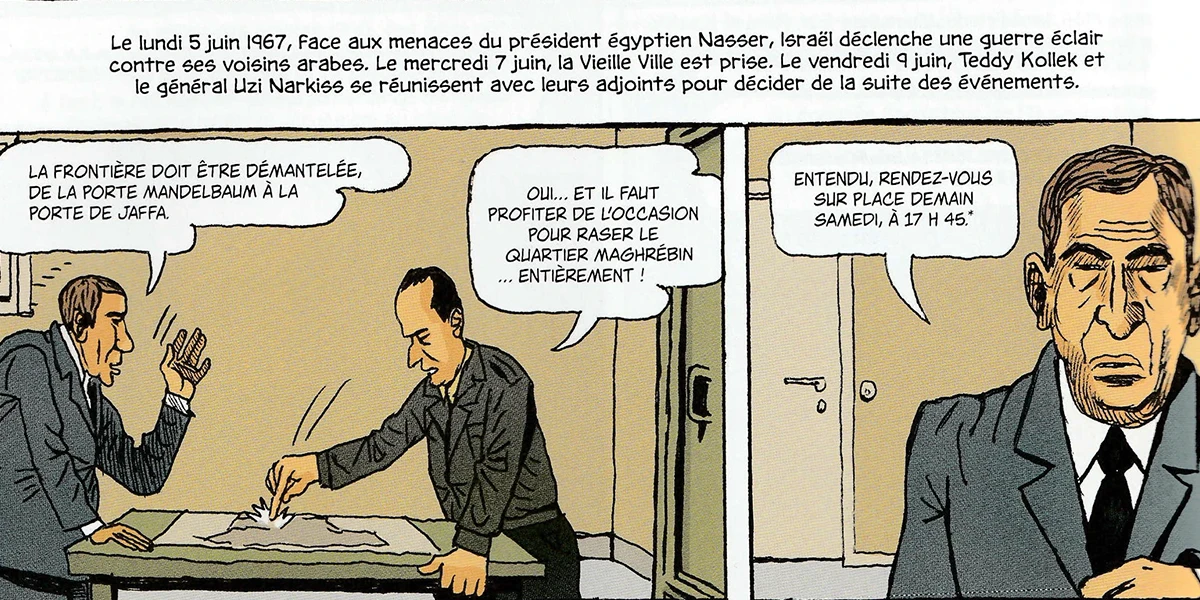
This Moroccan neighborhood, home to some 250 families, survived as it was until the Israeli army conquered the Arab part of Jerusalem. But in the space of a few days in June 1967, 90% of the neighborhood, which faced the Wailing Wall, was razed to the ground, and most of the families evicted on the night of June 10-11.
Some were compensated, but most were forced by military necessity to move to the outskirts of the city or to Palestinian towns and refugee camps on the West Bank.
After June 1967, families of Moroccan origin settled in Nablus, Al Khalil and Ramallah, and in the Palestinian refugee camps of Kalandia (Ramallah) and Al-Fawwar (Al Khalil).
The destruction of most of the Moroccan quarter by the Israeli army and the West Jerusalem municipal authorities was so swift and brutal that, by June 14 1967, the first Jewish pilgrimages could be held at the foot of the Wailing Wall. The Amman authorities had not permitted such pilgrimages since 1949.
Hay Al Maghariba, 2023
In a long article dated February 12, 2023, a few weeks after Vincent Lemire’s book “Au Pied du mur” (At the foot of the wall) and the completion of new archaeological excavations, Agence France Presse Jerusalem correspondent Claire Gounon notes “on the esplanade of the Wailing Wall, a gaping hole, hidden behind opaque palisades”.
“In this district of the Old City, destroyed in a matter of hours just after the Arab-Israeli war of June 1967 and the conquest of East Jerusalem by Israeli forces, archaeologists believed that nothing remained. In January, the unearthing of alleyways and residential remains by backhoe loaders came as a surprise.”
But,“ adds the AFP bureau chief, ”within a few days, the stones had been removed and the area levelled.” This is the story of an Israeli Antiquities Authority (AIA) that will deny any
“significant discoveries” and historian and researcher Vincent Lemire who will dispute these AIA claims.
In fact, walls, traces of paint, a paved courtyard, a drainage system, toys, kitchen utensils and tools were found. For the AIA, this was a “short excavation session” prior to work to solidify, stabilize and improve the infrastructure” of the Wailing Wall esplanade.
“Today, on the current square, there is no mention of the existence of a Maghrebi quarter for eight centuries”, except for a single Moroccan flag that flies discreetly in a garden near the esplanade.
Image source: Vincent Lemire and Christophe Gaultier, Histoire de Jérusalem, Les Arènes BD 2023