

“(…) Dear people,
Our interest in the internal affairs of our country cannot distract Us from the tragedy of the brotherly Palestinian people. In Our capacity as Chairman of the Al-Quds Committee, We have worked to open an unprecedented channel for delivering urgent food and medical aid to our brothers in Gaza. With the same responsible commitment, We continue to support constructive initiatives aimed at finding practical solutions for the conclusion of a concrete and lasting ceasefire and the recovery of the humanitarian situation. Moreover, the worsening situation in the region requires us to move away from the logic of crisis management towards the search for a definitive solution to this conflict, from the following standpoint: First: If achieving a cessation of hostilities in Gaza is an urgent priority, this must be done in parallel with opening up a political horizon likely to bring about a just and lasting peace in the region. Secondly: Recourse to negotiations to resuscitate the peace process between the Palestinian and Israeli parties means blocking the way to extremists on all sides. Thirdly: Security and stability will only be fully established in the region if this dynamic is embedded in the framework of the Two-State Solution, under which Gaza is an integral part of the territories of the independent Palestinian state, with Al-Quds Oriental as its capital (…).”
When King Mohammed VI delivered his traditional Speech from the Throne on July 29, 2024, the 15-minute address, which marked the 25th anniversary of his accession to the throne, addressed three main topics: water in Morocco, the Israeli-Palestinian conflict in the Middle East and, in one paragraph, a reminder and reaffirmation of the role Morocco wishes to play on the international stage: “We are also committed to enshrining the inviolability of territorial integrity, and to consolidating Morocco’s position as an influential player and a responsible, reliable partner at regional and international level”, the Sovereign stated clearly and succinctly.
This intervention, in its Palestinian aspect – the terms “Israeli” and “Israeli-Palestinian” are absent – is being made at a time when the war between Israel and Hamas is in its 10th month. The Hamas attack on military and civilian targets at dawn on Saturday October 7, with its trail of dead, wounded and kidnapped, provoked a brutal Israeli response, commensurate with the surprise and humiliation suffered by the Israeli government and army on that Saturday.
More than 10 months of war
As these lines are written, at the end of August 2024, Israel is counting its victims in the hundreds and the Palestinians in the tens of thousands, the vast majority in Gaza, as well as almost 700 in the West Bank. To this must be added the number of Palestinian prisoners in Israeli jails, which rises from over 5,000 in 2023 to almost 9,000 in 2024.
The enclave of Gaza, less than 400 km2 home to over 2.2 million Palestinians, mostly descendants of Palestinian refugees from the 1948 and 1967 wars, has been reduced to rubble. Everyone is dying: Hamas fighters and IDF soldiers, hostages, but also many women and children, journalists and aid workers. Hospitals, schools and universities no longer function. Water, food and medicines are in short supply. Contagious diseases have taken hold. Israeli politicians, including Avigdor Liberman on August 20, demanded that no more water, fuel or food be delivered to Gaza.
In the space of 10 months, the Gazan population has been displaced and relocated many times over, according to Israeli military plans. The Israeli and Palestinian belligerents and negotiators have mastered the art of killing, torturing and imprisoning at every turn, and of manipulating their allies and supporters, whether American or Qatari, among others, as well as international public opinion and the families of the 120 Israeli hostages and thousands of Palestinian prisoners.
Meanwhile, another war lasting over 10 months is also taking place on the Lebanese-Israeli border, pitting Israel against Hezbollah forces. Already in April 2024, after targeted assassinations by the Israeli army in Damascus, Iran retaliated by sending more than 300 drones and missiles towards the Jewish state. Americans, French, British, Jordanians and Gulf states had to support the Israelis in their defense.
Added to this, new Israeli targeted assassinations in Beirut and Teheran against Hezbollah and Hamas leaders in the final days of July 2024 raised tensions to a new level, prompting Teheran and Hezbollah to promise harsh reprisals against Israeli civilian and military targets.
The political, security, military and geopolitical situation in the Middle East, on the brink of regional explosion in the summer of 2024, is far from exhaustive.
Diplomatic baggage
The Moroccan monarch is no neophyte when it comes to the Middle East, even though when he acceded to the throne in July 1999, many observers seemed to indicate that Morocco’s diplomatic role in Israel-Palestine would be the first to suffer. This was not to be, despite the vicissitudes of Israeli-Palestinian relations, the constant threat of instability hanging over many Arab regions and states, and intra-Palestinian divisions.
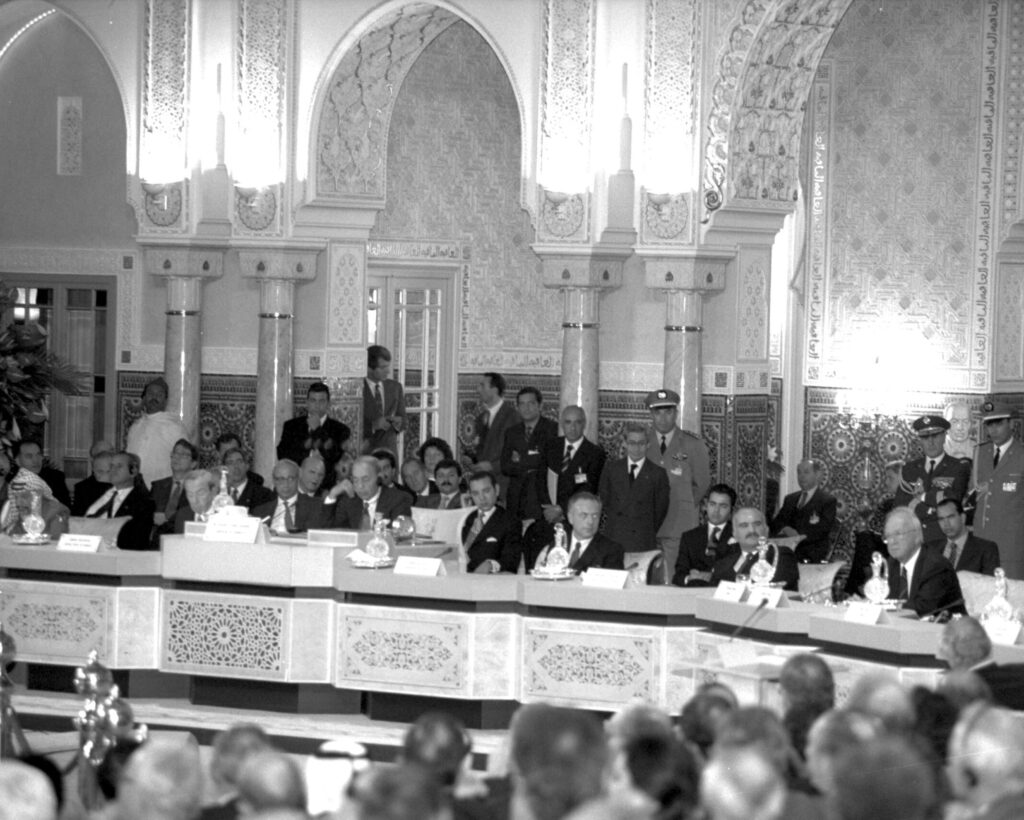
Just as Hassan II had initiated the welcoming of Yasser Arafat into the Arab diplomatic family as early as 1968, before supporting him in the integration of the PLO into the OIC and the Arab League, Mohammed VI would be the king to freeze Rabat’s relations with Tel Aviv in 2000, but would not hesitate to approve their resumption in 2020.
Rabat, with the regional stiffening of Algiers and the hostility of the Polisario and Iran, decided to take a step forward and assume its strategic orientations. In September 2020, as Manama and Abu Dhabi signed the Abraham Accords, a resumption of relations with Israel, in exchange for clear American and Israeli military and diplomatic support on the issue of Moroccan territorial integrity, became even more possible. The Palestinians feel somewhat let down, but Rabat has also decided to no longer tie its diplomatic and strategic orientations to those of others, especially when they are unpredictable and ineffective.
While part of Moroccan public opinion – over 65% in 2021 – was not in favor of the new Moroccan-Israeli normalization on principle and out of militant solidarity with the Palestinian cause, the Hamas attack of October 7, 2023 weakened, but did not threaten, the Moroccan diplomatic balancing act.
The Israeli military response against the population of Gaza and the widespread international condemnation radically shifted Moroccan public opinion in a pro-Palestinian and anti-Israeli direction. Since October 2023, pro-Gaza demonstrations have averaged weekly in some twenty Moroccan cities.
Each bombardment by the Israeli army of a school or hospital, with dozens of deaths in its wake, triggers new demonstrations, sometimes spontaneous, deployments of security forces in city centers, and the erection of barricades around Western consulates and embassies.
The PJD and Abdelilah Benkirane, who had criticized Moroccan diplomacy for its lack of firmness towards Tel Aviv as early as March 2023 and numerous incidents in the West Bank, will not hesitate to travel to Doha in August 2024 to present its condolences to Hamas and the family of Ismaïl Haniyeh. Haniyeh had led the Hamas delegation invited by the PJD to Morocco in June 2021, and had been received in particular by the Istiqlal, PAM and PPS parties.
From the summer of 1999 and Hassan II’s funeral, attended by Yasser Arafat as well as Ehud Barak – Prime Minister in Jerusalem since the previous May, thanks to a “little help” from Hassan II – and Bill Clinton, it will have escaped no one that after the assassination of Rabin, a man Mohammed VI had known, the electoral defeat of Peres in 1996, the rise to power of Netanyahu, the growing strength of the intifada and Arafat’s powerlessness in the face of his opposition and his inability to make a decision in the face of American proposals in the summer of 1999 and 2000, the Israeli-Palestinian issue continued to be highly inflammable. In fact, Rabat froze relations with Tel Aviv in March 2000, as did Tunis and Doha. In 2000, Mohammed VI was, for Palestinians and Israelis alike, the man who decided to suspend relations with Tel Aviv in view of the upsurge in the second intifadah and the number of Palestinian victims.
Of course, the late King Hassan II had dared, innovated and taken many risks and initiatives with the Israelis and Palestinians, but more often than not, Crown Prince Sidi Mohammed was never far away, especially from 1993 onwards. Again, a few months later, at the MENA (Middle East North Africa) Economic Summit in Casablanca in November 1994, Shimon Peres and Yasser Arafat. At that time, according to Palestinian diplomat Jamal Al Shobaki, Mahmoud Abbas (Abu Mazen), who was negotiating the Oslo Accords on behalf of the PLO, had a permanent office in Casablanca put at his disposal by the Rabat authorities.
In the company of his father, Sidi Mohammed met many Jewish dignitaries and Israeli politicians, notably in May 1999 in Marrakech. This was less than three months before his accession to the throne. At this reception, the Israeli-Palestinian question and the Israeli peace camp were discussed at length.
In 1999, Mohammed VI inherited an activist Moroccan diplomatic tradition in the Middle East, with relations established with Tel Aviv in September 1994 and with the Palestinian Authority the same year, as well as plans for an airport in Gaza and a faculty of agricultural and environmental sciences.
On his accession to the throne a few months later, he kept André Azoulay in the royal cabinet and appointed Serge Berdugo as ambassador-at-large in 2006.
In the years that followed, and despite the absence of formal Moroccan-Israeli relations, Mohammed VI exchanged views with Israeli Prime Minister Ariel Sharon and his Foreign Minister Silvan Shalom.
The sequence of events and the years 2000, 2010 and 2020 demonstrate that Mohammed VI’s diplomatic role has nothing to envy to that of Hassan II, if two different personalities from two different eras can be compared.
While Hassan II contributed to the beginnings of Israeli-Arab and Israeli-Palestinian peace, later sabotaged by Israeli and Palestinian extremists, Mohammed VI came to power in the middle of the summer of 1999, which saw the continuation of a cycle of attacks and repression in Palestine, heralding the worst.
Israel’s withdrawal from Gaza in 2005 and the dismantling of 4 Jewish settlements on the West Bank were positive developments in the region, prompting an exchange with Ariel Sharon. The 2006 Palestinian elections, with Fatah outvoted and Hamas victorious, provoked a brief Hamas-Fatah civil war in 2007, quickly followed by the takeover of the 390 km2 enclave by Sheikh Yassin’s successors. Mahmoud Abbas’s men left Gaza, including Mohamed Dahlan, Fatah’s top security official, who moved to Abu Dhabi. These developments represented major setbacks for peace and for the Palestinians.
During this time, however, and in the years that followed, Rabat continued to send humanitarian and medical aid to Gaza and to support educational institutions. In East Jerusalem, Bayt Mal Al Quds (BMAQ) also continues its work of providing humanitarian and educational support to many high-potential Palestinian families and young people through scholarships.
2018 will also see the first visit by a Moroccan head of diplomacy to Ramallah and the Al Aqsa Mosque esplanade, without prejudging Morocco-Israeli developments in December 2020.
At that time, the Trump administration had for some months taken a frank pro-Israeli turn, announcing in December 2017 its intention to transfer its embassy from Tel Aviv to Jerusalem, while relations between the Palestinian Authority and Washington had deteriorated sharply despite the meetings between Mahmoud Abbas and Donald Trump in May 2017 in Bethlehem and September 2017 in New York.
The official transfer of the US embassy to Jerusalem will take place in May 2018, as Israel celebrates its Independence Day, while at the same time clashes on the Gaza border will claim dozens of Palestinian lives.
As we know, the meetings between Palestinian chief negotiator Saeb Erekat and Trump’s diplomatic adviser Jared Kushner that same autumn of 2017 did little to change the American position on this subject, as well as on Washington’s announced desire to end Palestinian representation in Washington and American representation in East Jerusalem.
Demonstrations of Moroccan solidarity with the Palestinian cause in early 2018 did not prevent Rabat from keeping its channels open with Tel Aviv.
September 2018 saw a meeting between Nasser Bourita and Benjamin Netanyahu in New York. A few months later, Moroccan and Israeli diplomats and intelligence officials held at least two meetings in Washington to begin considering what was to become the Tripartite Agreement of December 22, 2020.
This agreement, as we now know, had been previewed on Twitter on the previous December 10 by President Trump and a Moroccan communiqué sanctioning a telephone call between Mohammed VI and Mahmoud Abbas.
A few days later, the diplomatic and visa procedure for the visit of a Hamas delegation to Rabat was launched by the PJD (Islamist party), whose leader and Prime Minister at the time, Saâd Eddine El Othmani, had initialed the Morocco-Israel-United States agreement of December 22, 2020.
The visit took shape some six months later, in the aftermath of a new phase of war lasting 11 days in May 2021 between Israel and Hamas.

The Tripartite Agreement included a section on the development of Morocco-American economic and security relations and the re-establishment by Morocco and Israel of diplomatic relations at liaison office level initially, but with commitments on the rapid establishment of direct air links and the development of economic and academic exchanges in particular. With hindsight, in light of the Abraham Accords obtained by the Trump administration in the region, the diplomatic successes of Jerusalem and Washington, intra-Palestinian divisions and Algiers’ hostility towards Rabat and the important issue of its territorial integrity, Rabat’s choice was to gradually clarify its hesitations.
After the telephone exchange between Mohammed VI and Mahmoud Abbas on December 10, 2020, Mohammed VI’s message on November 29, 2021, the anniversary of UN Resolution 181 on the partition of Palestine, confirmed the clarification of Morocco’s position.
A further royal speech in August 2022 confirmed the “prism” through which relations with Morocco’s partner-countries are gauged, followed by the short paragraph from the July 2024 speech quoted above.
In essence, to sum up Morocco’s diplomatic position on the Palestinian issue, Rabat is at the disposal of those, Israelis and Palestinians alike, who want peace and a two-state solution, while in this scheme there is no room for Hamas or Islamic Jihad on the Palestinian side, nor for the parties of Finance Minister Bezalel Smotrich or Internal Security Minister Itamar Ben Gvir on the Israeli side. If there is such a thing as having a choice of interlocutors in situations of war and conflict.